
Why shop with us
Brand: FULTON
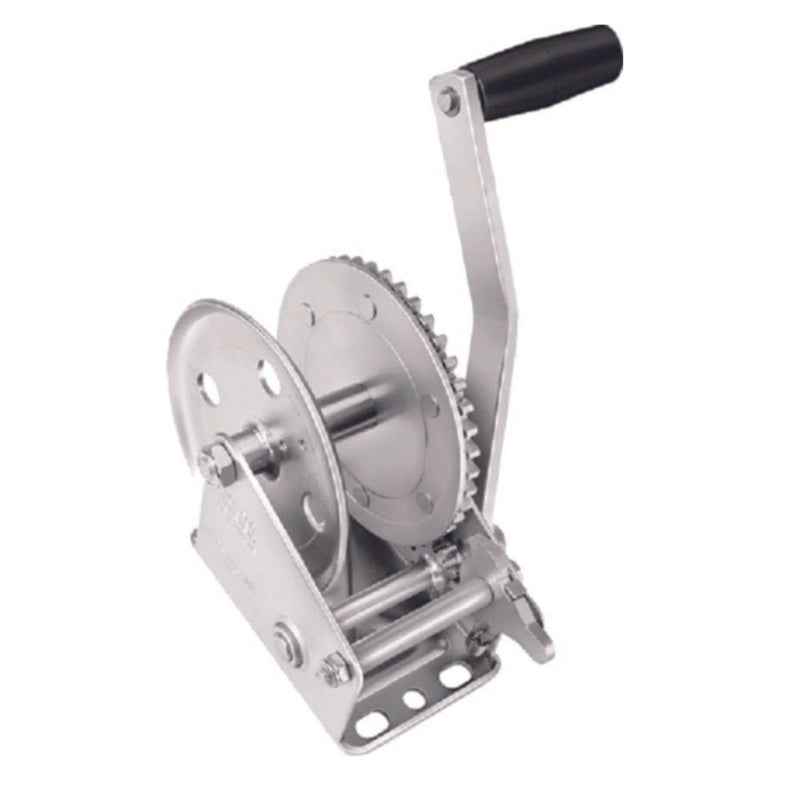
Single Speed Fulton 142103 Winch - 1300 lbs. Capacity, 1 Pack
Fulton 142103 single speed winch has a 1300 lbs. capacity.
Currently out of stock
No hidden fees — taxes included in the price & Free Shipping.
We accept major cards and digital wallets. Additional installment plans, when available, are offered by Shopify at checkout based on order eligibility.
Single Speed Fulton 142103 Winch - 1300 lbs. Capacity, 1 Pack

Fulton brand winches, single speed, are designed to meet your toughest pulling demands.
Efficient gear ratios feature in our winches, along with our 'comfort grip' handle for ease of cranking.
High-Carbon steel is used for all gears, ensuring superb strength and long-term durability.
Rigidity for gear alignment and longer cycle life is provided by stamped carbon steel frames.
Excellent corrosion resistance in all environments is offered by industry-leading, 600 zinc plating, which has a 600 hour salt spray rating per ASTM B117.
For over 50 years, Fulton has produced the finest winches in the industry.
The result of superior materials, rugged manufacturing, and engineering innovation, Fulton winches cover the greatest applications for your unique needs.
Ranging from the stylish and innovative F2 winch to a wide variety of one-speed and two-speed winches, and our rugged brake winches, Fulton offers a style and capacity to meet virtually every need.
When selecting a winch, you'll generally need to: 1) determine the environment (wet environment, saltwater) 2) determine the capacity needed (Fulton winches range from 600 lbs.
to 2100 lbs.) 3) determine whether a single-speed or multi-speed winch is required (cranking resistance) 4) determine whether a braking solution is needed to assist in managing the load (safety, pay-out).
To determine trailer winch capacity needed for pulling, total the weight of all items being pulled, i.e., boat, motor, fuel, gear, then divide by 2.
If the total weight of the boat, motor, fuel, and gear is 2,800 lbs., you would need a 1,500 lb.
winch (2,800 lbs.
divided by 2 = 1,400 lbs.).
If using a steep incline launch, divide by 1.5 instead of 2 due to the increased load on the winch from the incline.
For lifting, select a brake winch based on the amount being lifted, i.e., if lifting 1,450 lbs., you would need a winch rated at 1,500 lbs.
Key Features
Specifications
- Length
- 8.23 lb
- Width
- 6.41 lb
- Height
- 5.79 lb
- Weight
- 6.9 lb
- ASIN
- B01N1WLMAB
- UPC
- 016118135770
- Ships From
- United States
- Brand
- FULTON
Frequently Asked Questions
About Single Speed Fulton 142103 Winch - 1300 lbs. Capacity, 1 Pack
01 What is the capacity of the Fulton 142103 winch?
The capacity of the Fulton 142103 winch is 1300 lbs.
02 What type of handle does the Fulton 142103 winch have?
The Fulton 142103 winch has an 8 inch 'comfort grip' handle.
03 What materials are used in the gears of the Fulton 142103 winch?
The gears of the Fulton 142103 winch are made of high-carbon steel.
04 What is the ASIN for this product?
The ASIN for this product is B01N1WLMAB.
05 What is the UPC / barcode for this product?
The UPC/barcode for this product is 016118135770.
06 Where does this ship from?
Orders ship from our fulfillment center in Dover, Delaware, USA.
07 How many days will it take to arrive?
Orders ship within 1-2 business days and typically arrive within 4-5 business days via free standard shipping -- usually by Oct 14.
08 Does this product accept returns?
Yes -- this item can be returned within 15 days of delivery for a free return by mail. See our return policy for full details.

Special Offer
Single Speed Fulton 142103 Winch - 1300 lbs. Capacity, 1 Pack
Get 5% off this item today — code TRY5 at checkout.
$76.93
View Product