
Why shop with us
Brand: ARP
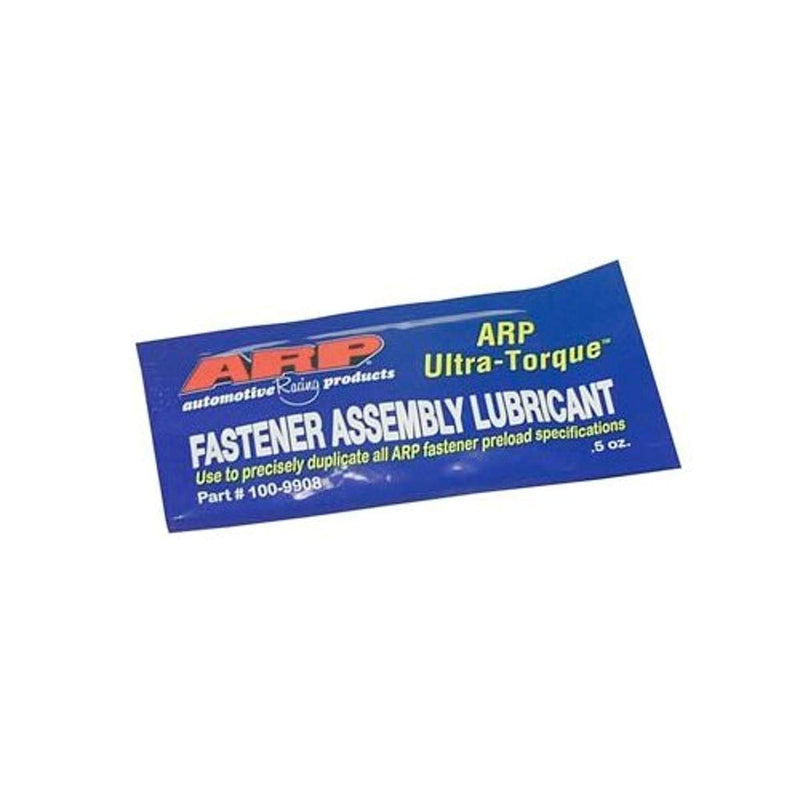
Ultra Torque ARP Foil Pack
ARP Ultra Torque Foil Pack is a lubricant for fasteners.
In stock, ready to ship
No hidden fees — taxes included in the price & Free Shipping.
We accept major cards and digital wallets. Additional installment plans, when available, are offered by Shopify at checkout based on order eligibility.
Ultra Torque ARP Foil Pack

Due to inconsistencies in friction with oil, moly, and other lubricants, multiple cycles of torqueing the bolt, loosening it, and then tightening it again are required to achieve the necessary preload or stretch.
When a fastener is initially tightened, the friction is at its highest level while the preload value or stretch remains low.
As the fastener undergoes numerous cycles, the friction decreases and the preload increases.
This occurrence is referred to as 'preload scatter.' With ARP Ultra Torque assembly lubricant, a fastener needs to be torqued only once to reach within 5 percent of the ideal preload, and it stays consistent through all following cycles, from race-prep machining to final assembly.
Additionally, due to the inconsistencies found in standard lubricants, it is possible for adjacent head bolts or studs to exhibit significantly different preloads.
This scatter can result in bore distortion, hinder piston ring seal, and lead to inadequate head gasket sealing.
Key Features
Specifications
- Length
- 4.5 lb
- Width
- 2.0 lb
- Height
- 0.13 lb
- Weight
- 0.03 lb
- ASIN
- B005JUX2HY
- UPC
- 672036000486
- Ships From
- United States
- Brand
- ARP
Frequently Asked Questions
About Ultra Torque ARP Foil Pack
01 What is the product type?
Product Type: Auto Accessory
02 What are the package dimensions?
Package Dimensions: 13.97 cm L x 7.62 cm W x 0.254 cm H
03 What is the country of origin?
Country of Origin: United States
04 What is the ASIN for this product?
The ASIN for this product is B005JUX2HY.
05 What is the UPC / barcode for this product?
The UPC/barcode for this product is 672036000486.
06 Where does this ship from?
Orders ship from our fulfillment center in Dover, Delaware, USA.
07 How many days will it take to arrive?
Orders ship within 1-2 business days and typically arrive within 4-5 business days via free standard shipping -- usually by Oct 13.
08 Does this product accept returns?
Yes -- this item can be returned within 15 days of delivery for a free return by mail. See our return policy for full details.

Special Offer
Ultra Torque ARP Foil Pack
Get 5% off this item today — code TRY5 at checkout.
$14.81